In high-volume manufacturing, minimizing cycle times while maintaining structural integrity is a constant engineering challenge. Hot melt adhesives (HMAs) provide an efficient solution by eliminating the need for drying time or chemical curing. Understanding exactly how hot melt adhesive works is critical for optimizing automated production lines. This is particularly true in demanding sectors like automotive assembly, filter manufacturing, and construction materials.
How does hot melt adhesive work?
Hot melt adhesive works through a rapid physical phase change. The thermoplastic polymer begins as a solid room-temperature resin. When heated above its melting point, it transforms into a low-viscosity liquid that easily wets a substrate surface. As the adhesive cools back to room temperature, it solidifies almost instantly. This creates a strong mechanical and chemical bond without releasing solvents or water.
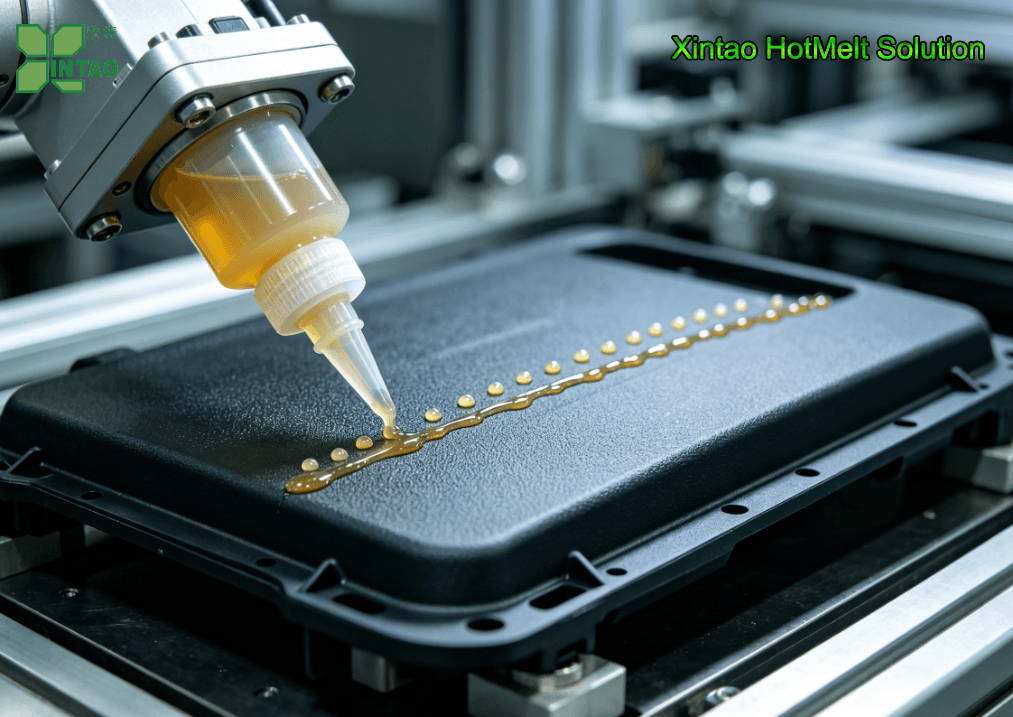
The Science of Thermoplastic Bonding
Unlike water-based or solvent-based glues, HMAs do not rely on evaporation. Instead, they depend entirely on precise temperature manipulation.
Heat dramatically reduces the melt viscosity of the polymer. A typical industrial HMA operates between 800 and 12,000 mPa·s at its target application temperature. This fluid state allows the liquid adhesive to flow into the microscopic pores and surface irregularities of the substrate.
Once the parts are pressed together, heat dissipates into the surrounding materials. The adhesive rapidly rebuilds its internal polymer network. This rapid cooling generates immediate cohesive strength. The bonded assemblies can handle immediate mechanical stress without clamping.
Core Polymer Families Used in Industrial Lines
Choosing the right thermoplastic base dictates the adhesive’s thermal stability, flexibility, and surface compatibility. Different polymer matrices serve entirely different manufacturing requirements.
- Ethylene-Vinyl Acetate (EVA): EVA is the industry standard for general assembly and packaging. It offers broad substrate compatibility and rapid setting speeds.
- Polyolefin (PO): Engineered for high thermal stability, PO adhesives resist charring in melting tanks. They are highly effective for automotive interiors and construction applications.
- Styrenic Block Copolymers (SBC): SBC formulations maintain permanent tack even after cooling. They form the foundation of pressure-sensitive adhesives (PSAs) used in tapes and labels.
| Polymer Base | Key Characteristic | Typical Application |
| EVA | Broad adhesion, cost-effective | Packaging, General Assembly |
| Polyolefin (PO) | High heat resistance, clean melting | Automotive, Construction |
| SBC (PSA) | Permanent tack, flexibility | Tapes, Medical Labels |
Selecting the Right Hot Melt Adhesive for Industrial Applications
Choosing the right hot melt adhesive requires more than selecting a polymer type. Manufacturers must consider substrate characteristics, production speed, application temperature, viscosity requirements, and long-term environmental conditions.
Different industries require different adhesive solutions. EVA hot melt adhesives are widely used for general assembly and packaging due to their excellent adhesion and cost efficiency. Polyolefin (PO) hot melt adhesives provide enhanced thermal stability and chemical resistance, making them suitable for demanding applications such as automotive components, filtration systems, and construction materials. SBC hot melt adhesives are preferred for pressure-sensitive applications where flexibility and permanent tack are essential.
As an experienced hot melt adhesive manufacturer, Xintao Hotmelt focuses on developing customized adhesive formulations based on specific industrial requirements. By adjusting polymer composition, viscosity, open time, and thermal performance, Xintao Hotmelt helps manufacturers achieve reliable bonding performance across different production environments.
The Four Stages of the HMA Application Process
Understanding the manufacturing workflow ensures precise bonding and prevents premature curing. Engineers monitor this sequence to guarantee structural integrity.
- Melting and Extrusion: Solid adhesive pellets or blocks enter a heated tank. The system raises the temperature (often around 180°C) until the material achieves the target flow rate.
- Dispensing: Heated hoses transfer the liquid to a dispensing nozzle or slot die. The equipment applies precisely metered beads, dots, or continuous films onto the primary substrate.
- Substrate Wetting: The adhesive remains in its liquid phase for a specific “open time,” typically ranging from 3 to 15 seconds. The secondary substrate must be mated before this thermal window closes.
- Compression and Curing: Mechanical pressure forces the liquid adhesive into the substrate. As it cools, the adhesive achieves structural lock, often yielding a 100% substrate tearing rate during destructive testing.
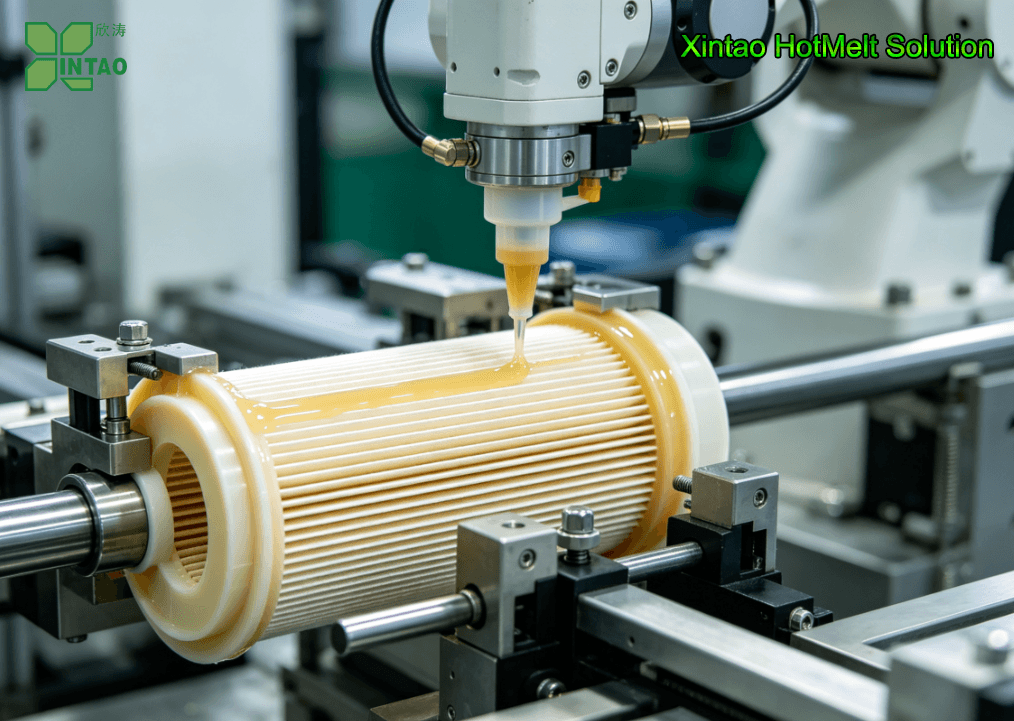
Critical Performance Parameters in Production Lines
Engineers must evaluate several physical properties to prevent bonding failures in harsh environments. Adhesives must match the exact rheological requirements of the dispensing equipment.
Viscosity and Penetration
Adhesives with excessively high viscosity will not penetrate dense substrates like coated automotive plastics. Low viscosity can cause bleed-through on porous construction membranes. Formulations must balance flow against material hold-out.
Temperature Resistance
Bonds must survive final end-use conditions. Advanced formulations maintain integrity across extreme temperature gradients. High-performance adhesives can resist cold cracking down to -15°C while maintaining thermal stability during high-heat exposure.
Open Time vs. Setting Time
Production line speed dictates formulation chemistry. High-speed carton sealing requires a fast set time of just 1 to 2 seconds. Large-area construction panels require extended open times to allow proper alignment before the adhesive solidifies.
Specialized Formulations for Automotive and Construction
Certain industrial sectors demand strict regulatory compliance and extreme durability. REACH and RoHS-certified adhesives are critical for maintaining global supply chain standards.
In automotive manufacturing, filter assembly and interior trim bonding require low-VOC, heat-resistant adhesives. Construction applications, such as waterproofing membranes, rely on modified polymers that resist moisture degradation and continuous UV exposure. Standard generic adhesives fail under these dynamic loads.
If you are specifying materials for demanding production lines, evaluating engineered polymer bases is essential. Manufacturers like Xintao Hotmelt provide highly specialized Polyolefin (PO) Adhesives, SBC Hot Melt Adhesives, and EVA Hot Melt Adhesives. Their formulations offer precise melt viscosities, tailored 3-15 second open times, and excellent low-temperature resistance, allowing engineering teams to replicate exact technical parameters for custom substrates.
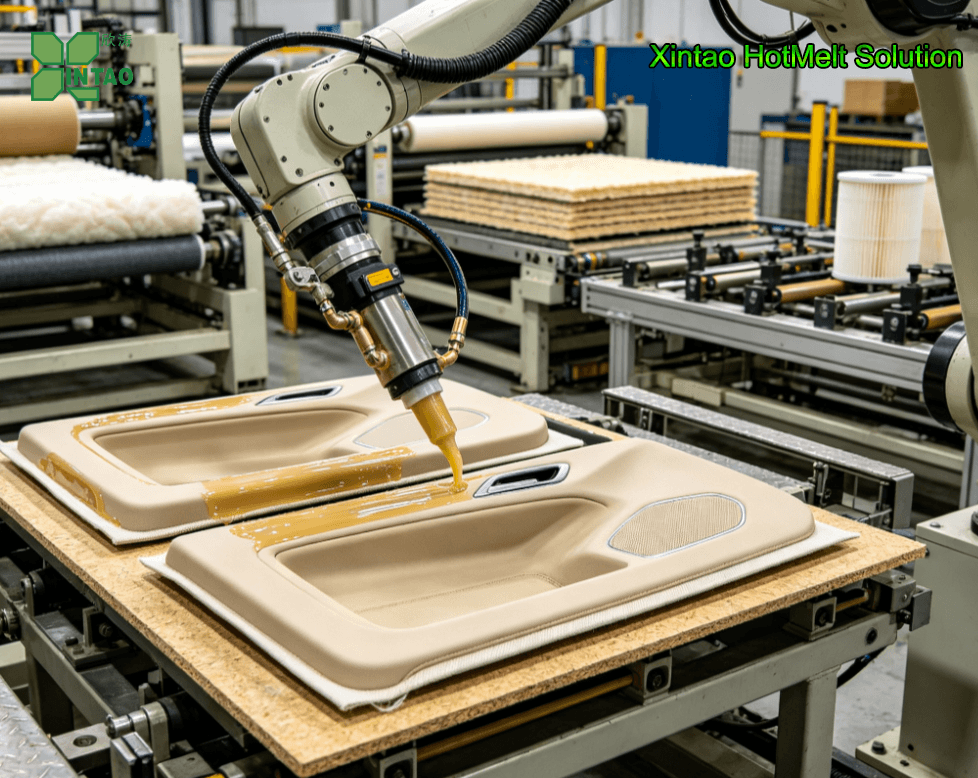
Why Partner with a Specialized Hot Melt Adhesive Manufacturer?
Industrial bonding performance depends not only on adhesive chemistry but also on formulation expertise and application support. A professional adhesive supplier can help optimize key parameters including melt viscosity, open time, setting speed, and temperature resistance.
Xintao Hotmelt develops thermoplastic adhesive solutions for manufacturers requiring stable performance and customized bonding characteristics. With expertise across EVA, Polyolefin (PO), and SBC hot melt technologies, Xintao Hotmelt supports industries ranging from automotive and filtration to construction materials and packaging.
By combining polymer technology with practical manufacturing experience, Xintao Hotmelt helps production teams improve bonding reliability, reduce process limitations, and achieve consistent results in high-volume manufacturing environments.
FAQ
What is the difference between open time and set time?
Open time is the maximum allowable window between applying the liquid adhesive and joining the second substrate. Set time is the duration required for the compressed adhesive to cool and develop sufficient bond strength to hold the parts together.
Why does hot melt adhesive fail on certain plastics?
Adhesion failure on plastics usually occurs due to low surface energy. Substrates like untreated polyethylene or polypropylene resist liquid wetting. Engineers resolve this by using specially formulated Polyolefin (PO) adhesives or by pretreating the plastic surface with corona discharge.
Do thermoplastic adhesives require chemical curing?
No. Thermoplastic hot melt adhesives bond entirely through a physical phase change. They transition from a hot liquid to a cool solid without requiring moisture, UV light, or chemical cross-linking agents to cure.
What temperature do industrial hot melt adhesives melt at?
Industrial hot melt adhesives typically require melting tank temperatures between 160°C and 180°C. However, exact application temperatures depend on the specific polymer formulation and the target melt viscosity required for the dispensing nozzles.
Reference Sources
- ASTM D4497: Standard Test Method for Determining the Open Time of Hot Melt Adhesives.
- ISO 16037: European structural standards for evaluating the performance of thermoplastic adhesive bonds in industrial applications.
- Adhesive and Sealant Council (ASC): Technical engineering guidelines on polymer phase changes and surface energy wetting in automated manufacturing.