In high-speed automated packaging, the choice of adhesive is often the difference between a seamless production run and a costly maintenance shutdown. For engineers and OEM project managers, “hot melt adhesive for packaging” is not a singular product category but a spectrum of chemical formulations—each designed to solve specific bonding challenges on the factory floor.
Whether you are sealing recycled corrugated cases or forming complex trays for cold-chain logistics, selecting the right polymer base is critical. Xintao Hotmelt specializes in engineering these solutions, focusing on the three primary chemistries that define the modern packaging industry: EVA, Polyolefin, and SBC.
The Technical Logic of Adhesive Selection
The performance of a packaging line is measured by “Total Cost of Ownership” (TCO). A lower-cost adhesive that chars in the tank, clogs nozzles, or fails during transit in high-heat shipping containers is ultimately more expensive than a high-performance alternative.
When evaluating hot melt solutions, technical experts prioritize three variables:
- Set Speed: Does the adhesive solidify fast enough for the line’s compression section?
- Thermal Stability: Can the material withstand 24/7 heating without oxidation or viscosity shifts?
- Substrate Compatibility: How does the adhesive interact with high-recycled content or coated surfaces?
Material Breakdown: EVA vs. PO vs. SBC
Understanding the molecular strengths of different materials allows for smarter procurement. Xintao Hotmelt categorizes its solutions based on these performance tiers:
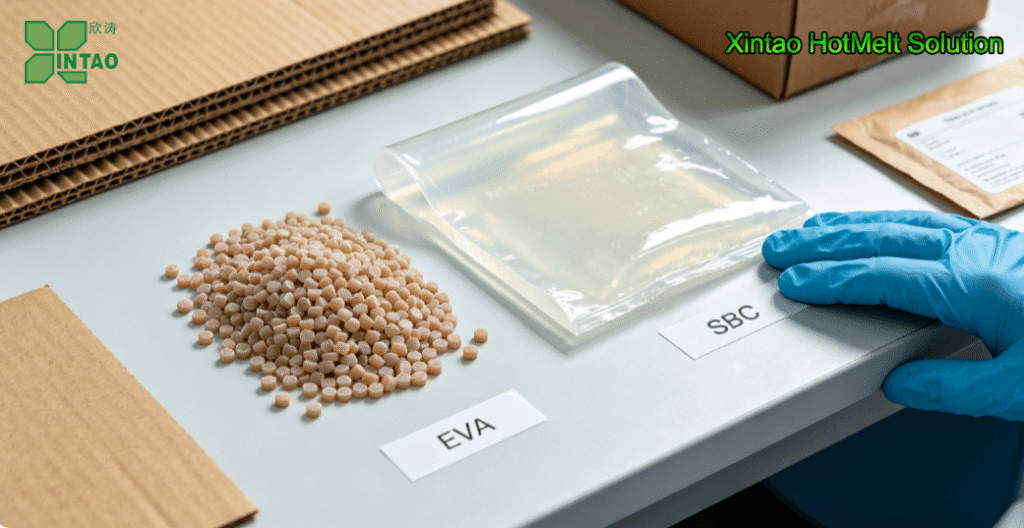
1. EVA (Ethylene Vinyl Acetate) Adhesives
Xintao’s EVA hot melt adhesives are the industry standard for general-purpose carton sealing. They offer an excellent balance of cost and versatility.
- Best For: Standard corrugated boxes and paperboard.
- Strength: Immediate “hot tack” (the ability to hold the flap down while still molten).
- Limitation: EVA is prone to “charring” if left in the melt tank for too long at high temperatures, requiring more frequent nozzle cleaning.
2. Polyolefin (PO) / Metallocene Adhesives
For high-performance lines, Xintao’s Polyolefin (PO) adhesives represent the next generation of bonding technology.
- Best For: Difficult-to-bond surfaces, deep-freeze environments, and high-heat shipping.
- The “Mileage” Advantage: PO adhesives have a lower density than EVA. This means that for the same weight of adhesive, you get more volume, effectively reducing consumption by 15-20%.
- Machine Uptime: Their exceptional thermal stability means they do not char, drastically reducing maintenance downtime and spare parts costs for applicators.
3. SBC (Styrenic Block Copolymers)
Xintao’s SBC hot melt adhesives are primarily used as Pressure Sensitive Adhesives (PSA).
- Best For: Courier bags, self-adhesive labels, and tamper-evident packaging.
- Strength: They maintain “tack” even after cooling, providing high shear strength and flexibility, which is essential for flexible packaging that must withstand rough handling during last-mile delivery.
Solving Real-World Packaging Challenges
Combatting “Pop-Opens” in High-Speed Lines
A common failure in high-volume manufacturing is the “pop-open,” where the carton flap springs open after the compression belt. This usually indicates a mismatch between the line speed and the adhesive’s Set Time. Xintao Hotmelt engineers formulations specifically to match the RPM of modern Krones or Bosch packaging systems, ensuring the bond reaches structural integrity in milliseconds.
Cold Chain Integrity
For the food and pharmaceutical industries, standard adhesives often become “glassy” and brittle at sub-zero temperatures, leading to bond failure in freezers. Using specialized PO formulations ensures the adhesive remains ductile, maintaining the seal even at temperatures as low as -40°C.
Adhesion to Recycled Corrugated Board
Modern sustainability goals have led to an increase in recycled content in packaging. Recycled fibers are shorter and often contain waxes or residual coatings that repel standard adhesives. Transitioning to a high-performance Xintao Polyolefin adhesive provides the necessary penetration to create a “fiber tear” bond, where the paper fails before the adhesive does—the hallmark of a secure seal.
Operational Optimization for B2B Procurement
From a B2B procurement perspective, the focus is on supply chain reliability and technical support. Working with a dedicated manufacturer like Xintao Hotmelt offers several advantages:
- Customization: Adhesives can be tuned for specific open times or viscosities to match unique machinery requirements.
- Compliance: All formulations are engineered to meet international safety standards, including FDA 21 CFR 175.105 for indirect food contact.
- Sustainability: By using high-stability PO adhesives, factories can reduce material waste and energy consumption (by running at lower application temperatures).
Why Technical Managers Trust Xintao Hotmelt
In the B2B landscape, an adhesive is a critical component of the production ecosystem. Xintao Hotmelt doesn’t just provide glue; we provide bond reliability. By integrating advanced polymer science with a deep understanding of packaging machinery, we help manufacturers reduce downtime and ensure their products reach the consumer in perfect condition.
FAQ: Hot Melt Adhesive for Packaging
Q: What is the ideal application temperature for packaging hot melt?
A: Most EVA-based adhesives run between 150°C and 170°C. However, Xintao’s high-performance Polyolefins can often be applied at lower temperatures (120°C – 140°C), which reduces energy costs and improves operator safety.
Q: How do I prevent nozzle clogging in my packaging line?
A: Nozzle clogging is usually caused by the thermal degradation (charring) of the adhesive. Switching to a more thermally stable Polyolefin (PO) adhesive from Xintao is the most effective way to eliminate char and reduce maintenance.
Q: Can I use the same adhesive for both recycled board and coated cartons?
A: While some versatile EVA grades exist, it is generally recommended to use a PO-based adhesive for coated or high-energy surfaces to ensure adequate wetting and long-term bond strength.
Q: Is Xintao Hotmelt adhesive safe for food packaging?
A: Yes, Xintao’s packaging-grade hot melts are formulated to comply with FDA and EU regulations for indirect food contact, making them suitable for cereal boxes, frozen food trays, and dry food secondary packaging.
Reference Sources
- ASTM D3236: Standard Test Method for Apparent Viscosity of Hot Melt Adhesives and Coating Materials.
- FDA 21 CFR 175.105: Adhesive regulations for food-grade packaging.
- FEICA (Association of the European Adhesive & Sealant Industry): Best practices for hot melt application in paper and board.
- ISO 9001:2015: Quality Management Standards followed by Xintao manufacturing facilities.