The evolution of modern bookbinding has transitioned from traditional cold glues to high-speed thermal bonding, with Ethylene-Vinyl Acetate (EVA) hot melt adhesive remaining the industry standard. For print finishing professionals and OEM project managers, selecting the right adhesive formulation is not merely about “sticking paper together.” It is a technical decision involving substrate compatibility, thermal stability, and mechanical durability.
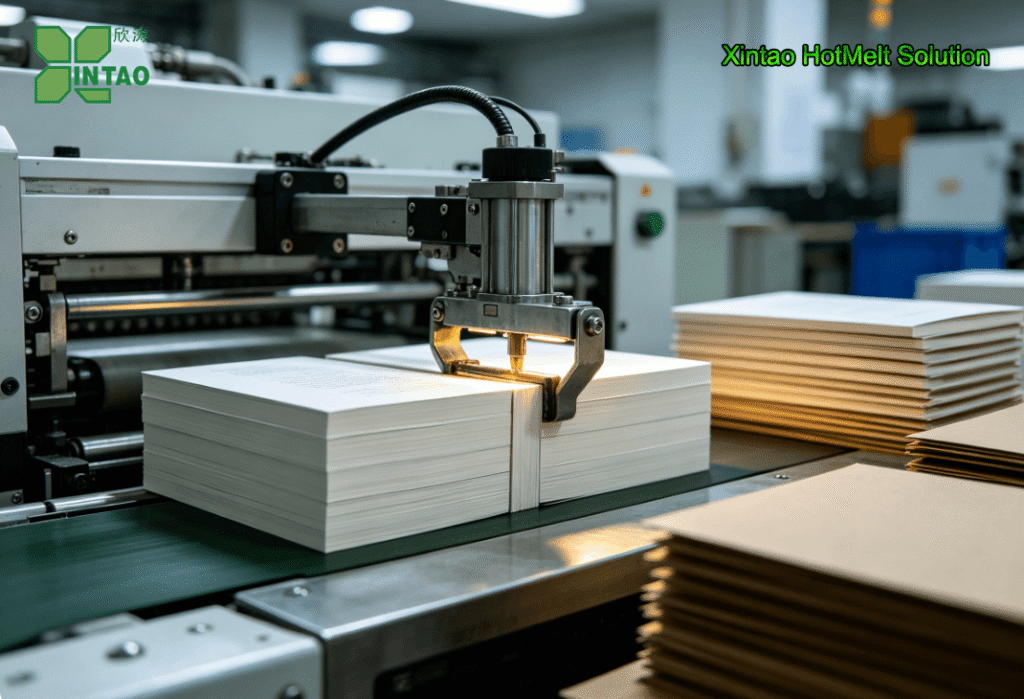
EVA hot melt adhesive for bookbinding and printing is a thermoplastic polymer system. It remains solid at room temperature and liquefies upon heating, allowing for rapid application and near-instantaneous setting. In the context of high-volume manufacturing, this “instant bond” is what enables binding lines to operate at speeds exceeding 10,000 cycles per hour.
Understanding the Chemistry: VA Content and Performance
The performance of an EVA adhesive is primarily dictated by its Vinyl Acetate (VA) content and the melt index. In industrial bookbinding, the VA percentage typically ranges between 18% and 28%.
- Higher VA Content: Increases flexibility and adhesion to difficult substrates, such as coated art papers. However, it may reduce the heat resistance of the spine.
- Lower VA Content: Enhances the hardness and heat resistance of the bond but can lead to brittleness in cold environments, potentially causing the “spine cracking” phenomenon.
Engineers must balance these ratios to ensure the book remains intact during both shipping in hot containers and usage in freezing climates.
Technical Properties of EVA in Print Finishing
When evaluating EVA hot melt adhesive for bookbinding and printing, four technical parameters define the success of the production run:
- Viscosity (Flow Control): Usually measured in centipoise (cP) at 160°C or 180°C. Low viscosity allows for better penetration into the paper fibers (fiber tear), while high viscosity provides better “gap-filling” for thick signatures.
- Open Time: The window of time after the glue is applied but before it sets. In bookbinding, the open time must be long enough for the cover to be positioned and nipped, but short enough to prevent shifting.
- Setting Time: The time required for the adhesive to reach handling strength. Fast setting times are critical for inline trimming operations to prevent “clogging” the knives.
- Softening Point: This determines the adhesive’s ability to withstand high temperatures. A low softening point might lead to glue “bleeding” if books are stored in a non-climate-controlled warehouse.
Key Advantages of EVA Hot Melt Adhesive in Bookbinding
EVA Hot Melt is the proven and economical choice for general bookbinding applications, offering fast setting, reliable adhesion, and easy production integration.
| Feature | EVA Hot Melt Adhesive |
|---|---|
| Set Speed | Fast setting within seconds, enabling high-speed production |
| Flexibility | Good flexibility with reliable spine performance |
| Cost | Economical solution with excellent cost efficiency |
| Recyclability | Easy to recycle and compatible with standard paper recycling processes |
| Substrate Range | Suitable for offset, uncoated, and light-coated papers |
| Equipment | Simple and easy-to-maintain hot melt application systems |
| Application | Widely used for paperback books, magazines, catalogs, and general bookbinding applications |
Primary Applications in the Printing Industry
EVA adhesives are versatile enough to handle various stages of the finishing process. Most professional binding lines, such as those from Muller Martini or Kolbus, utilize specific EVA formulations for different parts of the book.
Spine Gluing (Perfect Binding)
This is the most critical application. The adhesive must penetrate the notched or grinded spine of the book block. EVA provides a “square back” look that is aesthetically pleasing and structurally sound for standard paperbacks and catalogs.
Side Gluing
Side glue is applied to the first and last pages of the book block to bond the cover to the sides. This requires a different formulation—usually one with higher tack and a thinner application—to ensure the cover doesn’t “wing” or peel away during use.
Hardcover Casing-In
In high-speed hardcover production, EVA is used for joint gluing and attaching the endpapers to the case. Its ability to bond to various cloth and plastic-coated cover materials makes it indispensable for premium editions.
Benefits of EVA Hot Melt for High-Volume Production
For a manufacturing facility, the benefits of EVA extend beyond the bond strength.
- Production Efficiency: Because EVA does not require a chemical curing process, books can move directly from the binding line to the trimmer and then to the shipping carton.
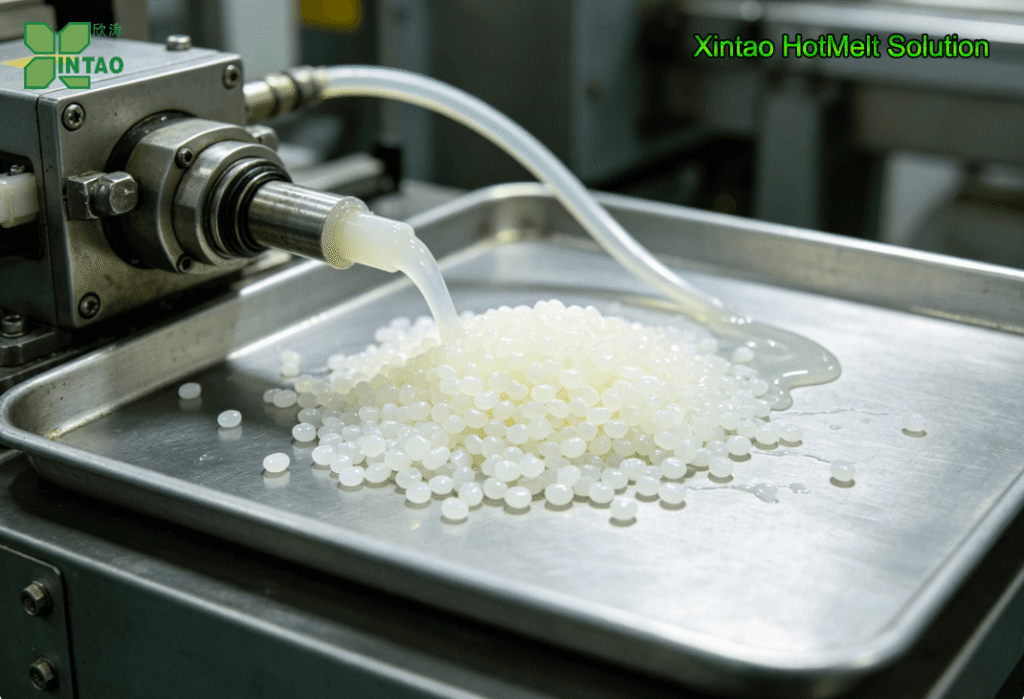
- Extended Shelf Life: EVA pellets are chemically stable. They do not react with atmospheric moisture, meaning they can be stored for long periods without losing performance.
- Operational Simplicity: Maintenance for EVA systems is significantly lower than for reactive adhesives. Clogged nozzles and tank “charring” are minimized with proper temperature management.
- Substrate Versatility: Xintao’s bookbinding solutions demonstrate that EVA can be optimized for everything from lightweight 60gsm offset paper to heavy 150gsm coated stocks by adjusting the polymer blend.
Addressing the Challenges of Digital Printing
A common hurdle in modern printing is the interaction between EVA glue and digital toners. Digital inks often contain fuser oils (silicone) that act as a release agent, preventing standard glues from sticking.
In these scenarios, engineers look for “high-synthetic” EVA formulations. These adhesives include specific tackifying resins designed to bite through the silicone barrier. If you are running high-speed digital presses, testing for “ink migration” is a mandatory step in the QA process to ensure the spine does not delaminate over time.
Environmental and Safety Considerations
Modern EVA adhesives are increasingly formulated with sustainability in mind.
- Low Odor: Advanced filtration and high-purity resins reduce the “fuming” typically associated with hot melt tanks, improving the factory floor environment.
- VOC Compliance: Most EVA formulations are 100% solids and solvent-free, meeting strict environmental regulations regarding Volatile Organic Compounds.
- Re-pulpability: During the paper recycling process, EVA can be more easily screened out than many liquid glues, supporting circular economy goals in the paper industry.
Need the Right EVA Hot Melt Adhesive Solution?
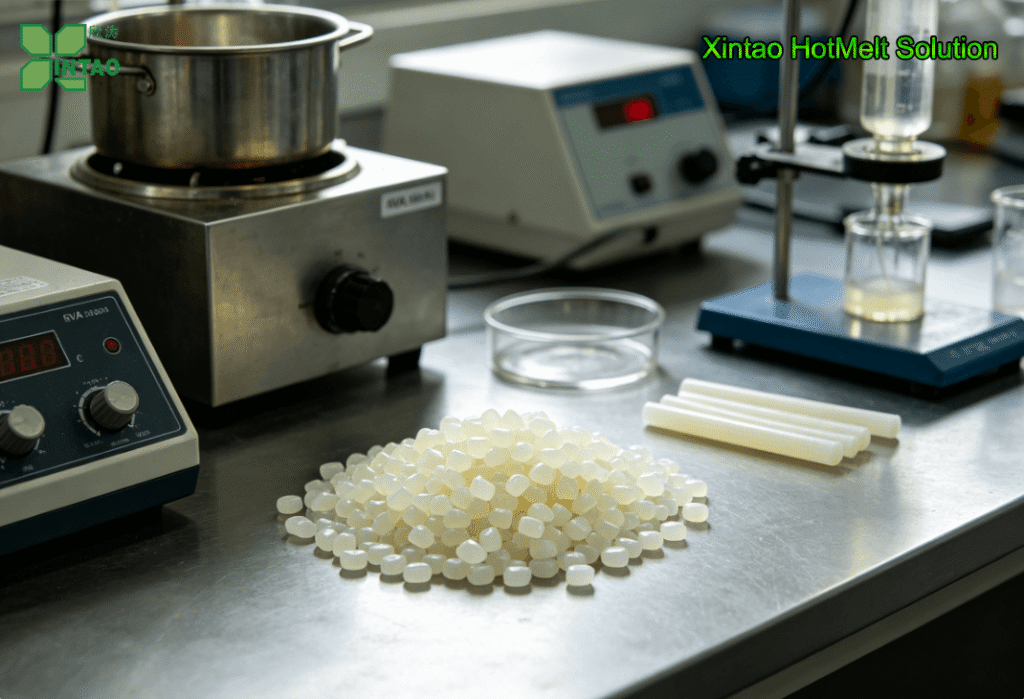
Xintao provides high-performance EVA hot melt adhesives for bookbinding and printing applications. With customized formulations and technical support, we help manufacturers achieve reliable bonding performance and efficient production.
Contact Xintao today for adhesive recommendations and sample testing.
FAQ
Q: What is the ideal application temperature for bookbinding EVA?
A: Most EVA hot melts for printing are applied between 160°C and 180°C (320°F – 356°F). Operating below this range results in poor penetration, while exceeding it can cause the polymer to degrade (char), leading to brittle bonds.
Q: Why does the glue sometimes crack when the book is opened?
A: This is usually due to “cold brittleness.” It happens if the adhesive has a low Vinyl Acetate content or if the book was stored in a very cold environment. Choosing a grade with higher flexibility or lower Tg (glass transition temperature) can solve this.
Q: Can I use the same EVA for both the spine and the side glue?
A: While possible, it is not recommended for high-quality production. Spine glue needs higher tensile strength and specific “open time” for nipping, while side glue needs higher “wet tack” to hold the cover wings in place immediately.
Q: How do I prevent “charring” in my melting tank?
A: Charring is caused by oxidation when glue is kept at high temperatures for too long. To prevent this, use a “melt-on-demand” system, keep the tank lid closed, and reduce the standby temperature by 20-30°C during lunch breaks or shifts.
Reference Sources
- ASTM D4498: Standard Test Method for Heat-Fail Temperature in Shear of Hot Melt Adhesives.
- TAPPI (Technical Association of the Pulp and Paper Industry): Guidelines for “Adhesives in Printing and Packaging.”
- Technical Data Sheets (TDS): Industry-standard documentation for Ethylene-Vinyl Acetate copolymers in industrial finishing.