In a mattress production line, adhesive selection directly affects assembly speed, material stability, and the final sleeping experience. Manufacturers working with pocket springs, memory foam, and compressed mattresses need adhesives that can maintain bonding performance during production, storage, and transportation.
Hot melt adhesives are widely used in modern mattress production because they offer fast bonding, clean processing, and compatibility with automated equipment, replacing traditional solvent-based alternatives due to their rapid setting times, environmental safety, and reliable bonding performance on common mattress materials such as nonwoven fabric, foam, and textiles. Whether you are assembling pocket spring units, bonding foam layers, or attaching pillow tops, understanding the technical nuances of hot melt chemistry is essential for optimizing your manufacturing workflow.
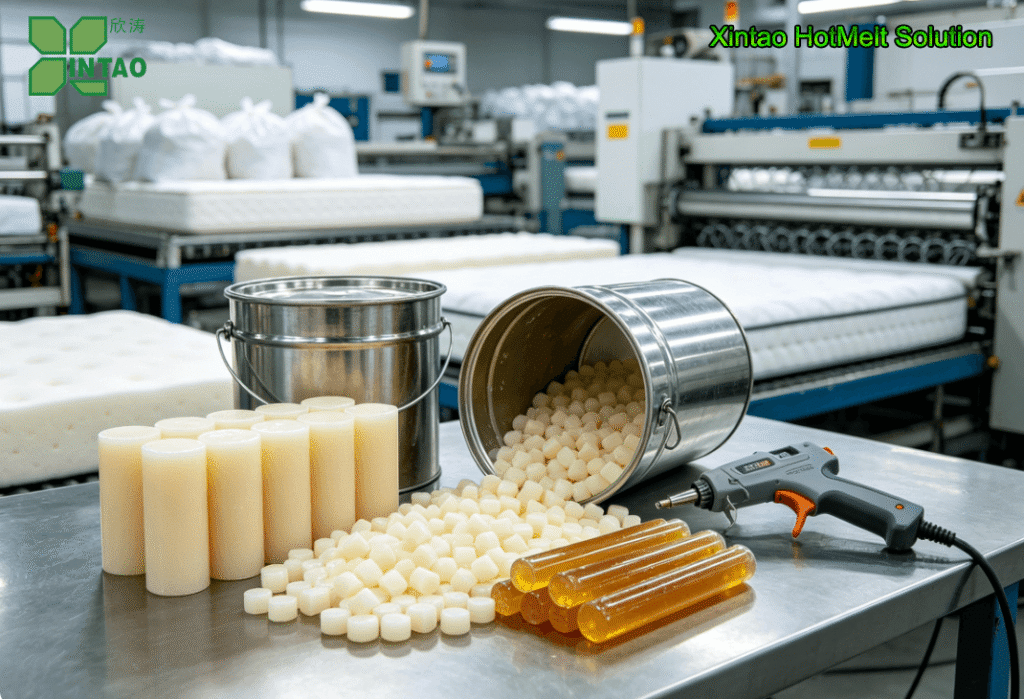
Why Hot Melt is the Standard for Modern Mattress Assembly
The transition from solvent-based glues to hot melt technology was driven by two primary factors: production speed and regulatory compliance. Unlike water-based adhesives that require long drying times or expensive infrared ovens, hot melt adhesives achieve structural bonds within seconds of cooling.
In the context of the mattress and furniture assembly sector, hot melt provides:
- Instant Green Strength: Allows for immediate packaging and shipping of mattresses (Roll-pack ready).
- VOC-Free Operations: Eliminates hazardous air pollutants, ensuring a safer workspace and a “low-odor” end product for consumers.
- Versatile Substrate Bonding: Effectively joins non-woven fabrics, latex, memory foam, and even high-density polyethylene (HDPE).
Critical Technical Parameters for Adhesive Selection
Choosing a hot melt adhesive for mattress manufacturing requires balancing several performance metrics. A failure to match the adhesive to the application method can lead to “noisy” mattresses or bond failure under high-tension “roll-packing” processes.
1. Open Time vs. Set Time
In automated lines, a short set time is required to keep the line moving. However, for manual assembly of large king-size layers, a longer “open time” is necessary to allow operators to align the foam layers before the adhesive hardens.
2. Softness and Noise Suppression
Low-quality hot melts can become brittle when cured, leading to a “crunching” sound when a user sits on the mattress. High-performance Pressure Sensitive Adhesives (PSA) remain flexible, ensuring silent operation and a soft “hand feel” through the fabric.
3. Heat Resistance and Creep
Mattresses are often stored in shipping containers where temperatures can exceed 50°C (122°F). The adhesive must resist “creep” (the sliding of layers) under these thermal stresses.
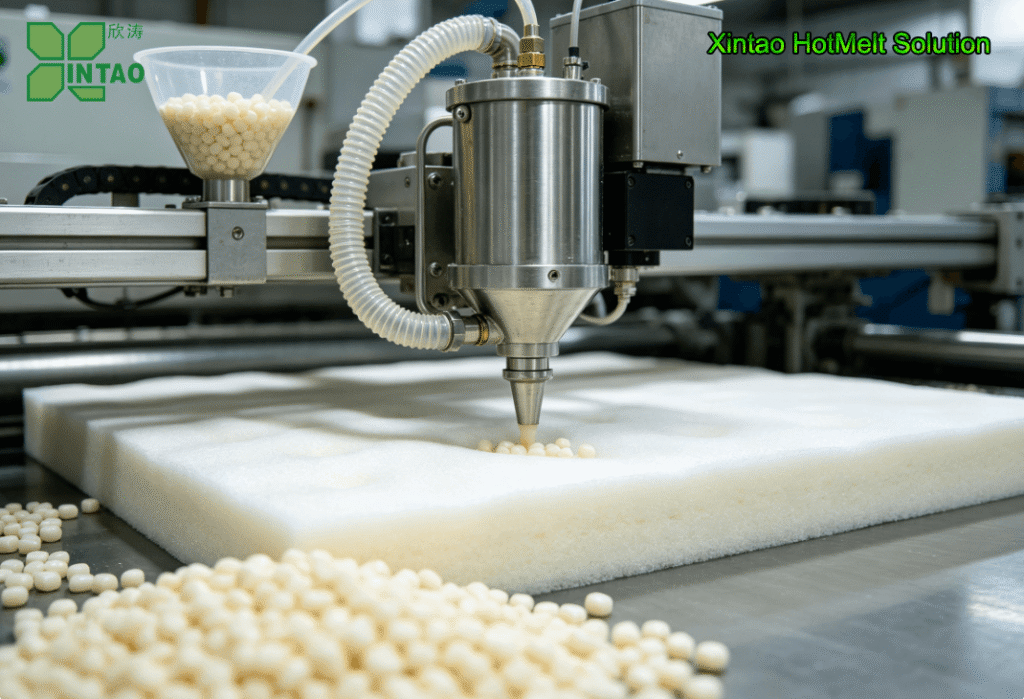
Application Scenarios in Mattress Manufacturing
Different sections of a mattress require specific adhesive characteristics. Modern facilities typically use a combination of technologies to minimize costs while maximizing performance.
| Application Area | Preferred Adhesive Type | Key Performance Requirement |
| Pocket Spring Assembly | PO (Polyolefin) or PSA | High shear strength and fast setting for high-speed coiling machines. |
| Foam Encasement | Hot Melt PSA | Strong initial tack to hold foam side rails against spring units under tension. |
| Top Layer / Pillow Top | Soft-grade PSA | Flexibility and zero-noise profile; must be compatible with memory foam. |
| Non-Woven Attachment | Standard PO / EVA | Cost-effective bonding for stabilizing layers. |
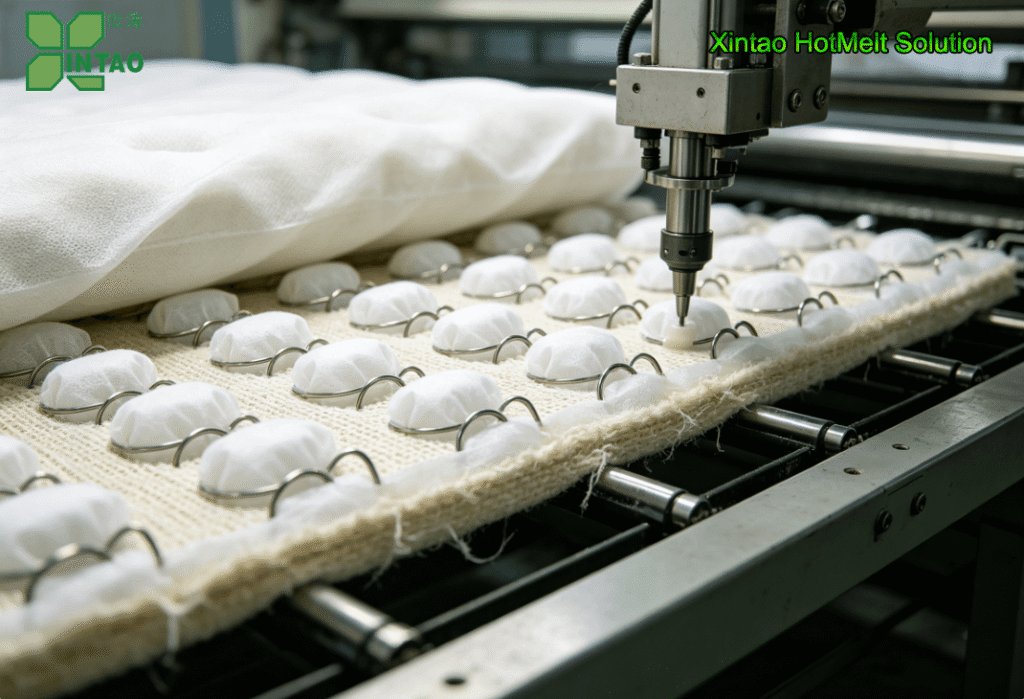
Pocket Spring Construction
For pocket spring units, the adhesive must be applied via high-speed nozzle systems. The bond must withstand the constant compression and expansion of the springs without delaminating from the non-woven fabric sleeves.
Foam-to-Foam Bonding
When bonding layers of memory foam or latex, the adhesive must not “soak” too deeply into the foam cells, which can harden the feel of the mattress. A spray application pattern is usually preferred here to achieve maximum coverage with minimum material weight.
Optimizing Production Efficiency with Xintao Solutions
For manufacturers looking to upgrade their assembly lines, Xintao’s Mattress solutions offer a specialized range of adhesives designed for high-speed automated environments. For roll-pack mattress manufacturers, one of the main concerns is whether the adhesive can withstand compression recovery after unpacking. This requires a balance between initial tack, flexibility, and long-term cohesion.
When a mattress is compressed and rolled, the adhesive bond faces extreme peel forces. Xintao’s pressure-sensitive formulations are engineered to maintain integrity under these stresses, ensuring the mattress recovers its original shape without internal displacement once unpacked by the consumer.
Best Practices for Adhesive Application
To maximize the ROI of your adhesive consumption, consider the following engineering adjustments:
- Temperature Control: Operating 10 degrees above the recommended temperature can degrade the polymer, while 10 degrees below can lead to “cold joints” and poor penetration.
- Pattern Optimization: Use swirl spray patterns for large surface areas to reduce adhesive weight by up to 30% compared to full-coat applications, without sacrificing bond strength.
- Equipment Maintenance: Ensure filters and nozzles are cleaned regularly to prevent “charring,” which causes inconsistent flow and spotting on high-end fabrics.
Sustainability and Regulatory Compliance
The mattress industry is under increasing pressure to meet CertiPUR-US® and REACH standards. Selecting a hot melt adhesive that is 100% solid (no solvents) is the most effective way to ensure your products meet global indoor air quality standards. Furthermore, modern Polyolefin (PO) hot melts are becoming increasingly popular because they are more easily recyclable than traditional EVA-based glues.
About Xintao Hot Melt Adhesives
Xintao is a professional hot melt adhesive manufacturer specializing in R&D and production of industrial bonding solutions. With decades of experience in adhesive technology, Xintao provides customized hot melt adhesives for mattress, furniture, packaging, and other manufacturing applications. Our technical team helps manufacturers improve bonding reliability, production efficiency, and product quality.
FAQ: Hot Melt Adhesive for Mattress Manufacturing
Q: Can hot melt adhesives be used with all types of foam?
A: Most hot melts are compatible with PU, memory foam, and latex. However, highly lubricated or fire-retardant treated foams may require a high-tack PSA (Pressure Sensitive Adhesive) to ensure proper wetting of the surface.
Q: How does roll-packing affect adhesive choice?
A: Roll-packing puts immense shear and peel stress on the bond lines. You must use an adhesive with high cohesive strength and permanent flexibility to prevent the layers from shifting while the mattress is tightly compressed.
Q: What is the typical shelf life of these adhesives?
A: Most industrial hot melt adhesives have a shelf life of 12 to 24 months if stored in a cool, dry place away from direct sunlight.
Q: How can we reduce the “glue smell” in new mattresses?
A: Use high-purity synthetic resin-based hot melts. These formulations have lower low-molecular-weight volatiles, resulting in almost zero odor immediately after application.
Q: What is the benefit of Polyolefin (PO) over EVA in mattress assembly?
A: PO adhesives generally offer better thermal stability (less charring in the tank) and higher bond strength at lower coat weights, though they may have a higher upfront cost per kilogram.
Reference Sources
- ISO 16000-6: Indoor air – Part 6: Determination of volatile organic compounds in indoor and test chamber air.
- ASTM D1876: Standard Test Method for Peel Resistance of Adhesives (T-Peel Test).
- SGS Technical Report: Comparative Analysis of Hot Melt vs. Water-based Adhesives in Furniture Assembly.
- Industry Association: International Sleep Products Association (ISPA) – Material Safety Guidelines.